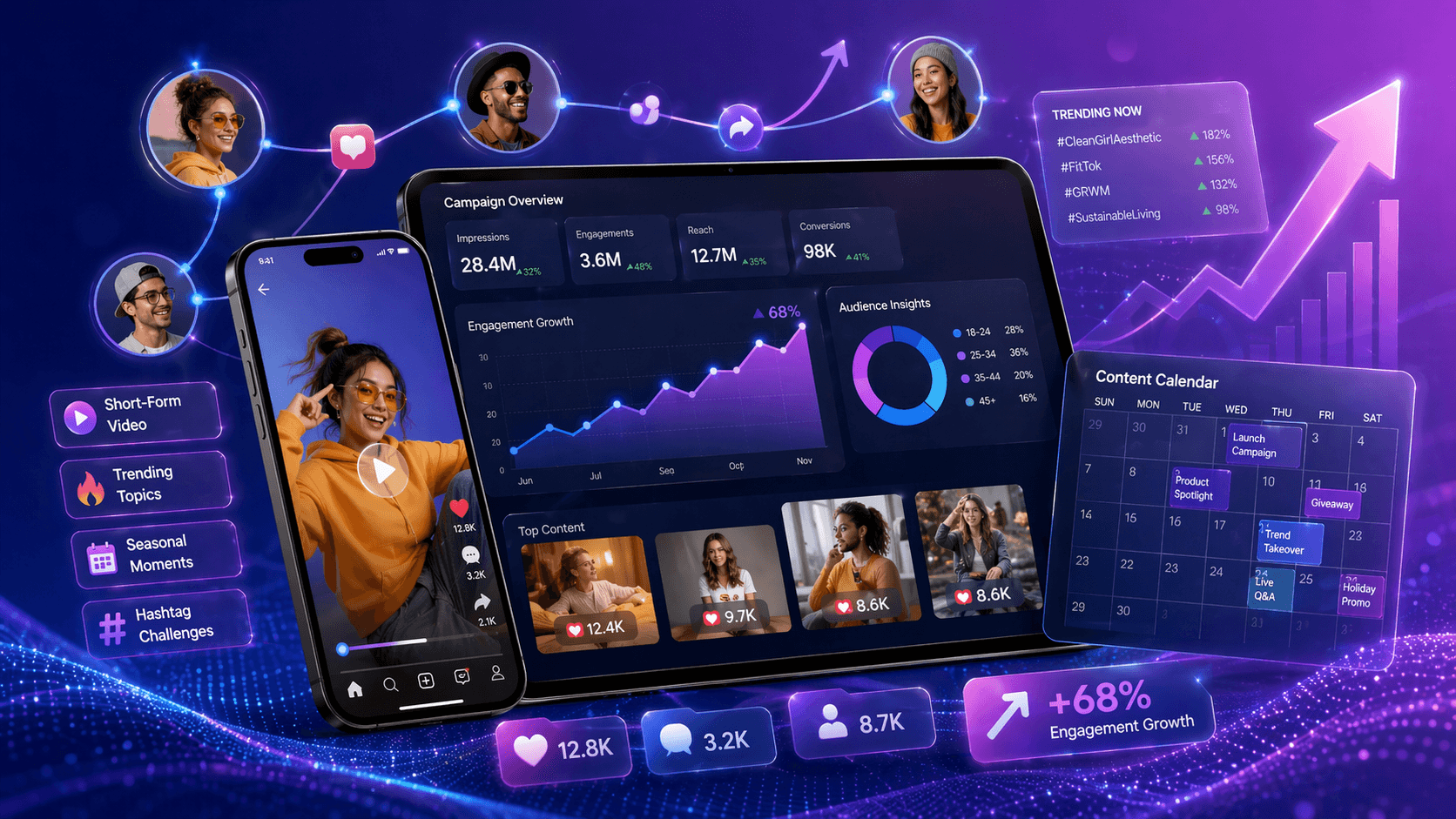

Influencer marketing trends are changing how campaigns earn attention, trust, and sales, so your plan needs to match how people actually consume content now. The good news is you do not need a bigger budget to get a bigger result – you need better distribution, tighter creative direction, and cleaner measurement. In practice, that means choosing formats that platforms are currently rewarding, building creator partnerships that can scale, and tracking outcomes beyond likes. This guide breaks down the trends that matter, how to apply them, and the numbers to watch so you can make decisions with confidence.
Influencer marketing trends that matter in 2026
Trends are only useful if they change what you do on Monday morning. Right now, the most practical shifts are about distribution mechanics and creator economics, not flashy new apps. First, short-form video remains the default discovery engine, but the winning creative looks less polished and more specific: problem – solution, before – after, and side-by-side comparisons. Second, brands are moving from one-off posts to repeatable series, because consistency improves both recall and platform learning. Third, “creator as media channel” is back in focus: brands want usage rights so they can repurpose winning content across ads, email, and product pages.
At the same time, social platforms are rewarding signals that correlate with satisfaction: watch time, saves, shares, and meaningful comments. That is why educational and utility-first content is outperforming generic lifestyle posts in many categories. Finally, audiences are more sensitive to authenticity and disclosure, so clear labeling and honest claims are part of performance, not just compliance. Takeaway: pick 2 to 3 trends that change your distribution plan and measurement, then build your brief around those, not around vague “awareness.”
Define the metrics and terms before you brief creators

Campaigns get messy when a team uses the same words to mean different things. Before outreach, define the terms you will use in your brief, reporting, and contracts. This prevents scope creep and makes performance comparisons fair across creators and platforms.
- Reach: unique people who saw the content at least once.
- Impressions: total views, including repeat views by the same person.
- Engagement rate: engagements divided by impressions or reach (you must specify which). A practical default is engagements divided by impressions for video-heavy platforms.
- CPM (cost per mille): cost per 1,000 impressions. Formula: CPM = (Cost / Impressions) x 1000.
- CPV (cost per view): cost per video view. Formula: CPV = Cost / Views.
- CPA (cost per acquisition): cost per purchase, lead, or signup. Formula: CPA = Cost / Conversions.
- Whitelisting: the creator authorizes the brand to run ads from the creator’s handle (often via platform permissions). This can improve ad performance because the ad looks native.
- Usage rights: permission to reuse creator content in other channels (paid ads, website, email) for a defined time and geography.
- Exclusivity: restrictions that prevent a creator from promoting competitors for a period of time.
Concrete takeaway: add a “Definitions” block to every brief and contract, and specify whether engagement rate is based on reach or impressions. For disclosure, follow the FTC’s guidance on clear and conspicuous endorsements: FTC Endorsement Guides.
Trend-driven campaign framework: brief, build, amplify, measure
To amplify a campaign, you need a workflow that treats creator content as the start of distribution, not the finish line. Use this four-step framework to keep teams aligned and to avoid wasting your best assets.
- Brief: set one primary objective, one secondary objective, and 3 to 5 non-negotiables (claims, talking points, do-not-say list, and disclosure).
- Build: commission multiple hooks and formats per creator so you can test quickly. Ask for raw files and captions as deliverables if you plan to repurpose.
- Amplify: republish, whitelist, and sequence content across channels. Use paid support only after you see early organic signals.
- Measure: report on leading indicators (watch time, saves, link clicks) and lagging indicators (sales, signups, lift).
To make this operational, create a single-page brief template and a shared tracker. If you want more planning templates and reporting ideas, keep a running reference to the InfluencerDB blog guides and link the relevant posts directly inside your internal briefs.
| Phase | Tasks | Owner | Deliverables | Quality check |
|---|---|---|---|---|
| Brief | Define objective, audience, offer, tracking, usage rights | Brand lead | 1-page brief + tracking links | Terms defined, CTA clear, disclosure required |
| Build | Creator onboarding, hook list, script outline, product ship | Creator manager | 2 to 3 hook options per asset | Hook matches audience pain point |
| Publish | Post schedule, community replies, pin comment, link placement | Creator + brand | Live post + screenshots | Caption includes CTA and disclosure |
| Amplify | Repurpose to Shorts, Reels, Spark Ads, whitelisting setup | Paid social | Ad-ready cuts + permissions | Brand safety review, correct aspect ratios |
| Measure | Collect platform metrics, UTMs, promo codes, post-mortem | Analyst | Weekly report + learnings | Compare to benchmarks and cost metrics |
Concrete takeaway: if you cannot name the owner for amplification and measurement, you are not actually running an amplifiable campaign. Assign those roles before you sign creators.
Formats and creative patterns that amplify naturally
Most “trend” talk stops at platform features, but amplification comes from repeatable creative patterns. Start by asking creators for multiple hooks, because the first two seconds decide distribution. Then, design content that earns saves and shares, since those signals often correlate with future reach. For example, a creator can turn one product into a three-part series: “what I wish I knew,” “my setup,” and “mistakes to avoid.”
Next, build for repurposing. Vertical video should be shot with clean framing and minimal copyrighted audio if you plan to use it in ads. Ask for a version without on-screen platform UI so you can cut it into paid placements. Also, consider a “comment-to-keyword” CTA where it fits, because it can drive engagement while keeping the post native. Takeaway checklist for your brief:
- Require 2 hook options and 1 alternate CTA per video.
- Specify the first line of on-screen text and the first spoken sentence.
- Ask for B-roll and raw clips as a separate deliverable.
- Include a repurposing plan: where else will this asset live?
For platform mechanics, follow official guidance on specs and ad formats so your repurposed cuts do not get rejected. For example, Meta’s documentation is the safest reference for placements and creative requirements: Meta Business Help Center.
Amplification tactics: repurposing, whitelisting, and sequencing
Once content is live, amplification is a set of deliberate moves, not a hope that the algorithm will be kind. Start with repurposing: cut one strong creator video into three edits with different hooks, then publish across your brand channels with platform-native captions. After that, use whitelisting to scale winners. When you run ads from the creator handle, you often get higher click-through rates because the ad looks like a post from a person, not a brand.
Sequencing is the other lever. Instead of running one ad to everyone, build a simple funnel: first show the creator’s “problem – solution” video to a broad audience, then retarget viewers who watched 50 percent with a proof asset (review, demo, or comparison), and finally retarget clickers with an offer. This approach also makes measurement cleaner because each step has a role. Concrete takeaway: do not whitelist everything. Only whitelist assets that hit pre-set organic thresholds in the first 24 to 72 hours, such as save rate, share rate, or view-through rate.
| Tactic | Best for | What to ask creators for | Risk to manage | Decision rule |
|---|---|---|---|---|
| Repurpose to brand channels | More reach from one asset | Raw file, clean captions, thumbnail frame | Usage rights not covered | Repurpose only if rights include owned social |
| Whitelisting | Performance scaling | Ad authorization, handle permissions, no copyrighted music | Creator brand safety, comment moderation | Whitelist only top 20 percent assets by early signals |
| Creator series | Recall and trust | 3-part arc, consistent format, recurring CTA | Audience fatigue | Stop after part 2 if retention drops sharply |
| Community amplification | More saves and shares | Creator replies, pinned comment, FAQ answers | Off-brand replies | Provide response guidelines and escalation rules |
Budgeting and pricing with simple formulas (CPM, CPV, CPA)
Amplification decisions get easier when you translate creator fees into comparable cost metrics. Start with what you can observe: impressions, views, clicks, and conversions. Then calculate CPM, CPV, and CPA so you can compare creators, formats, and paid support on the same scale.
Example CPM calculation: You pay $2,500 for a Reel that delivers 120,000 impressions. CPM = (2,500 / 120,000) x 1000 = $20.83. If your paid social CPM is $12, that does not automatically mean the creator is “expensive,” because creator content can drive higher trust and better downstream conversion. Still, CPM gives you a baseline for negotiation and for deciding what to whitelist.
Example CPV calculation: You pay $1,800 for a TikTok that gets 90,000 views. CPV = 1,800 / 90,000 = $0.02 per view. If your goal is top-of-funnel reach, that might be strong. If your goal is purchases, you need CPA.
Example CPA calculation: You spend $6,000 across three creators and get 120 purchases tracked via UTMs and codes. CPA = 6,000 / 120 = $50. Compare that to your margin and lifetime value to decide whether to scale. Concrete takeaway: set a target CPA range before launch, and decide in advance what you will do if you beat it by 20 percent (scale) or miss it by 20 percent (pause and fix).
Measurement and reporting: what to track, how to attribute, how to learn
Better reporting is the fastest way to improve your next campaign. Start with a measurement plan that matches your objective. For awareness, prioritize reach, impressions, view-through rate, and share rate. For consideration, track link clicks, landing page views, and email signups. For sales, you need conversions and revenue, ideally with a consistent attribution approach.
Use UTMs for every creator link and keep naming consistent: source = creator handle, medium = influencer, campaign = launch name, content = format. Pair UTMs with a creator-specific promo code so you have a backup signal when links break or when purchases happen later. If you run whitelisted ads, separate reporting for organic versus paid is essential, otherwise you will over-credit the creator fee for paid results.
Finally, run a structured post-mortem. Pull the top 10 percent and bottom 10 percent posts, then compare them on hook type, length, CTA placement, and comment themes. This is where “trend” becomes repeatable learning. Concrete takeaway: require creators to send 24-hour and 7-day screenshots for key metrics, because platforms sometimes change what is visible later.
Common mistakes that kill amplification
- Over-briefing the script: you get stiff content that performs poorly. Instead, brief the point, not the sentence.
- No rights, no scale: if usage rights and whitelisting are not negotiated up front, you cannot amplify winners without delays.
- One asset per creator: you cannot test hooks, so you learn less and waste spend.
- Measuring only likes: likes alone rarely predict sales. Add saves, shares, and click quality.
- Inconsistent tracking: missing UTMs and messy code usage make results impossible to trust.
Concrete takeaway: if you fix only one thing, fix rights and tracking before launch. Those two items determine whether you can scale and whether you can prove impact.
Best practices to turn trends into repeatable growth
Trends come and go, but a few operating principles keep paying off. Build a creator bench in tiers so you can test cheaply and scale confidently. Use micro creators for fast iteration, then bring in larger creators once you know the message and hook that works. Also, treat creators like partners: share performance feedback and let them improve the next cut.
On the creative side, standardize what should be standardized: brand claims, disclosure, tracking links, and deliverable specs. Leave the rest flexible so creators can stay native to their audience. For distribution, plan amplification before you post: decide which assets will be repurposed, which will be whitelisted, and what your sequencing will look like. Concrete takeaway checklist:
- Pre-negotiate usage rights, whitelisting, and exclusivity terms.
- Commission 2 to 3 hooks per asset and test quickly.
- Set early-signal thresholds for paid amplification.
- Report weekly with CPM, CPV, and CPA, not just engagement.
- Document learnings in a shared playbook so the next campaign starts smarter.
If you want to keep your team current without chasing noise, make it a habit to review one tactical playbook per month from the and add the best ideas to your brief template. That is how influencer marketing trends become a system, not a scramble.