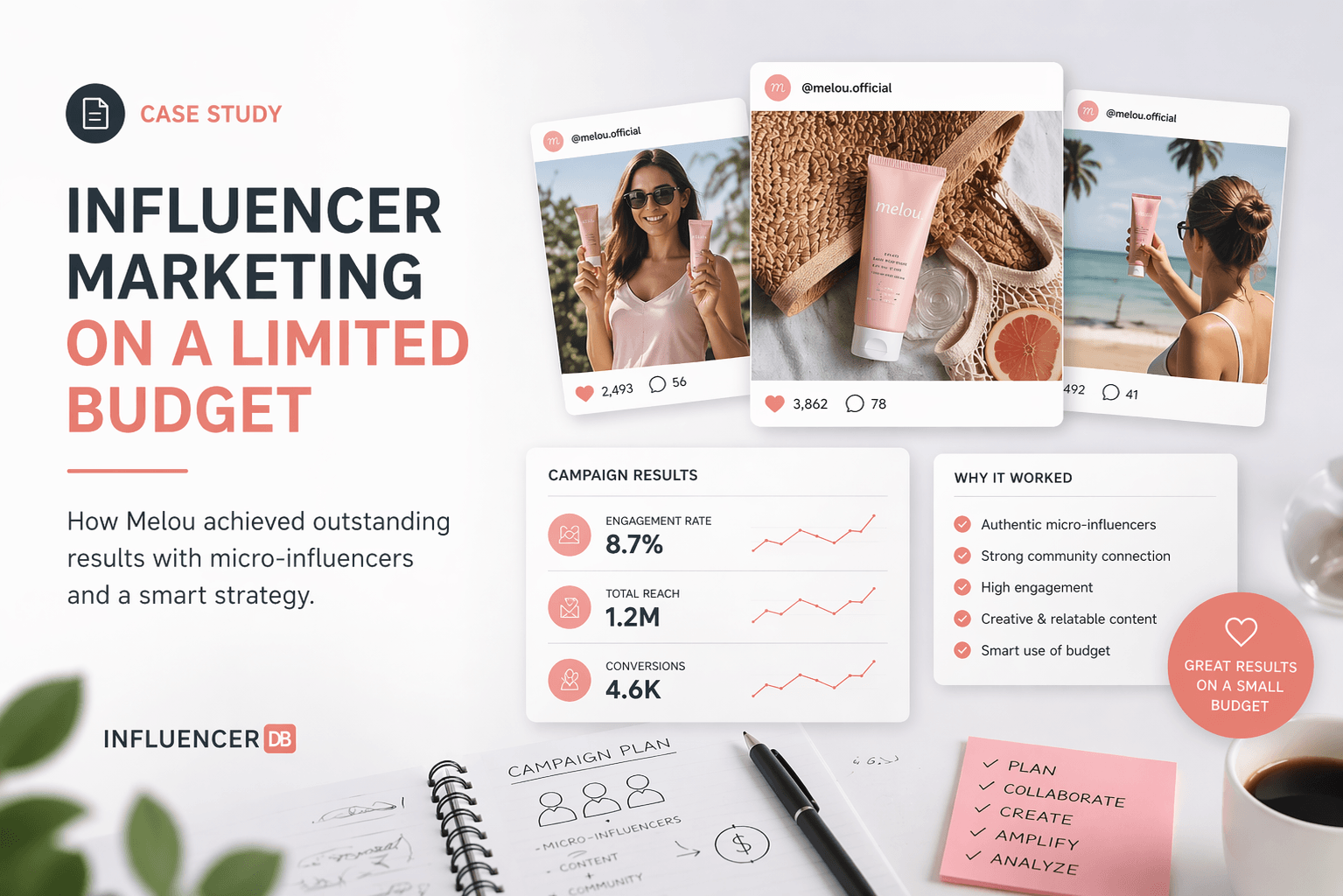

Limited budget influencer marketing is not about finding the cheapest creator – it is about buying the right proof of performance with terms you can actually afford, and the Melou case study shows how to do it. Melou is a small consumer brand with a tight monthly cap, a short runway to prove traction, and no appetite for vanity metrics. The team needed creators who could move product, not just generate likes, so every dollar had to be tied to a measurable outcome. In practice, that meant a simple offer, a lean testing plan, and clear rules for what to scale and what to cut. Below is the exact framework Melou used, with definitions, benchmarks, tables, and negotiation scripts you can reuse.
What “limited budget influencer marketing” really means
A limited budget does not automatically mean “micro only” or “gifted only.” It means you have constraints – cash, time, inventory, team bandwidth – and you need a campaign design that respects them. Melou set three constraints up front: a hard spend ceiling, a maximum of two rounds of revisions per creator, and a requirement that every post be trackable. As a result, they prioritized creators who could deliver strong storytelling in one take and who were comfortable with simple tracking links and codes. The key takeaway: define your constraints before you define your creator list, because constraints determine the right deal structure.
Before you plan, align on the terms you will use to judge success:
- Reach – the number of unique people who saw the content.
- Impressions – total views, including repeat views by the same person.
- Engagement rate (ER) – engagements divided by reach or followers (be explicit which one). A practical formula is: ER by reach = (likes + comments + saves + shares) / reach.
- CPM – cost per thousand impressions. CPM = cost / impressions x 1000.
- CPV – cost per view (often for video). CPV = cost / views.
- CPA – cost per acquisition (purchase, signup, etc.). CPA = cost / conversions.
- Whitelisting – running ads through the creator’s handle (also called creator licensing for ads).
- Usage rights – permission to reuse content on your channels, ads, email, or website, for a defined time and scope.
- Exclusivity – the creator agrees not to work with competitors for a period.
Melou’s decision rule was simple: if a creator could not support basic tracking and clear terms for usage rights, they were not a fit, even if their rate looked attractive.
The Melou case study setup: goals, audience, and offer
Melou started with a narrow goal: generate first purchases at a target CPA while collecting enough creative to fuel future ads. That clarity prevented a common budget trap – paying for broad awareness when you actually need conversions. The team defined one primary audience segment and one secondary segment, then wrote a single-sentence value proposition creators could repeat without sounding scripted. They also chose one hero product to avoid spreading inventory across too many SKUs. The takeaway: with small budgets, focus beats variety, because every extra message increases briefing time and dilutes learning.
They also set a measurement hierarchy:
- Primary KPI – purchases (tracked via code and UTM link).
- Secondary KPIs – landing page views, add-to-carts, and email signups.
- Creative KPI – save rate and hook retention (for video), used to decide what to repurpose.
To keep reporting lightweight, Melou used a single spreadsheet plus platform-native metrics screenshots. If you want a simple way to standardize your process, the InfluencerDB blog guides on influencer marketing workflows are a useful reference point for templates and terminology.
Budget math that works: benchmarks, formulas, and a pricing table
Melou treated every creator post like a media buy with creative upside. Instead of asking “Is this creator expensive?” they asked “What CPM and CPA would make this worth it?” That shift made negotiations easier, because the team could explain their ceiling in performance terms. They also separated content value from distribution value: even if a post underperformed, the content could still be worth paying for if usage rights were included. The takeaway: decide your acceptable CPM and CPA ranges before you start outreach, then back into a maximum fee.
Here are practical benchmark ranges Melou used to sanity-check quotes. These are not universal rates – they are guardrails to spot outliers and ask better questions.
| Platform | Creator tier | Typical deliverable | Common fee range | What to verify before paying |
|---|---|---|---|---|
| TikTok | Micro (10k to 50k) | 1 video | $150 to $600 | Average views on last 10 posts, hook strength, comment quality |
| Micro (10k to 50k) | 1 Reel + 3 Story frames | $250 to $900 | Story views, saves, audience location, brand fit | |
| YouTube | Micro (10k to 50k subs) | Short integration | $300 to $1,200 | Avg views per video, audience retention, link click history |
| Any | Nano (1k to 10k) | 1 post | $0 to $250 (often gifted) | Consistency, on-camera comfort, responsiveness, niche credibility |
Melou’s quick CPM check looked like this:
- Expected impressions – use the creator’s median impressions, not their best post.
- Target CPM – set a range you can live with (example: $12 to $25 for awareness-style placements).
- Max fee – max fee = expected impressions / 1000 x target CPM.
Example: If a creator’s median Reel impressions are 18,000 and your target CPM is $20, your max fee is 18,000 / 1000 x 20 = $360. If the creator quotes $700, you can counter with $360 plus a performance bonus, or ask for usage rights and extra story frames to justify the gap.
Creator selection on a small spend: a repeatable audit checklist
Melou avoided the “big follower” trap by using a lightweight audit that took 10 minutes per creator. First, they filtered for creators whose content already matched the brand’s tone, because heavy creative direction increases revision cycles. Next, they checked whether engagement looked real: comments that referenced the video, not generic praise, and a steady pattern of views rather than spikes. Finally, they looked for evidence of purchase intent, such as followers asking where to buy or creators sharing links regularly. The takeaway: with limited budget, you cannot afford long discovery cycles, so use a checklist and move fast.
Melou’s audit checklist:
- Audience fit – top countries and cities align with shipping markets; age range matches buyer.
- Content fit – creator can demo the product naturally within their usual format.
- Consistency – at least 2 to 4 posts per week, with stable baseline views.
- Signal of trust – followers ask for recommendations and the creator answers.
- Brand safety – no recent controversial posts; tone is compatible with your category.
- Operational fit – replies within 48 hours; can deliver by your deadline.
For disclosure and compliance, Melou required clear labeling on sponsored posts. If you operate in the US, review the FTC’s influencer guidance and keep it in your contract: FTC Endorsement Guides and influencer disclosures.
Negotiation and deal structure: how Melou bought performance, not hype
Melou used three deal structures depending on creator size and confidence. For nanos, they offered gifted product plus a small fixed fee to ensure delivery. For micros, they offered a lower base fee plus a performance bonus tied to tracked sales. For a few standout creators, they added paid usage rights so the brand could run the content as ads later. The takeaway: when cash is tight, you can still be fair by paying for effort and adding upside for results.
Here is the structure Melou used most often:
- Base fee – covers creation and posting.
- Performance bonus – example: $5 to $12 per sale after the first 10 sales, capped.
- Usage rights add-on – 30 to 90 days for brand social and paid ads, priced separately.
- Exclusivity – only if necessary, and only for a narrow competitor set and short window.
Melou’s negotiation script was simple and specific: “We can do $X for one Reel plus three story frames, and we add $Y per sale after Z sales. If you include 60-day paid usage rights, we can increase the base by $A.” That approach avoided vague back-and-forth and made creators feel respected.
| Term | What it means | Why it matters on a small budget | Suggested starting point |
|---|---|---|---|
| Usage rights | Permission to reuse content | Turns one post into multi-channel creative | 30 to 60 days, organic + paid, brand-owned channels |
| Whitelisting | Run ads via creator handle | Often improves CTR and trust | Optional add-on, require ad preview and spend cap |
| Exclusivity | No competitor deals | Can inflate fees quickly | Avoid unless you are scaling a winner |
| Revisions | Rounds of edits pre-post | Time sink for both sides | Max 1 to 2 rounds, focus on claims and brand safety |
| Payment terms | When creator gets paid | Cash flow control | 50% on approval, 50% within 7 days of posting |
Tracking and ROI: the exact measurement plan Melou used
Melou kept tracking intentionally boring. Every creator got a unique discount code and a UTM-tagged link to a dedicated landing page. That setup let the team separate “creator A drove sales” from “the brand’s email drove sales,” even when posts happened close together. They also asked creators to send screenshots of reach, impressions, and saves within 48 hours of posting, which reduced missing data. The takeaway: the best tracking system is the one creators will actually use without reminders.
Melou’s minimum tracking stack:
- UTM link – source=creatorname, medium=influencer, campaign=melou_test1.
- Creator code – easy to say on video, easy to remember.
- Landing page – one page per campaign, not per creator, to keep maintenance low.
- Reporting sheet – cost, deliverables, post date, reach, impressions, clicks, sales, CPA.
ROI math stayed straightforward:
- Gross profit = revenue x gross margin.
- Contribution = gross profit – creator cost – shipping or fulfillment promos (if applicable).
- ROI = contribution / creator cost.
Example: A $400 creator package drives $1,600 in revenue at a 60% gross margin. Gross profit is $960. Contribution is $960 – $400 = $560. ROI is $560 / $400 = 1.4. Melou used a scaling rule: scale only if ROI stayed above 1.0 after two posts or if the content produced a top 20% save rate and could be repurposed into ads.
For platform measurement definitions, it helps to align with official terminology. YouTube’s documentation is a solid reference for how views and watch time are counted: YouTube Analytics basics.
Creative brief that creators actually follow (with a one-page template)
Melou’s brief was one page, because long briefs do not get read on mobile. It included three non-negotiables, two optional talking points, and a clear list of prohibited claims. Instead of dictating a script, the brand asked for a specific “hook style” and a specific “proof moment,” such as showing the product in use within the first three seconds. The takeaway: constrain the outcome, not the creator’s voice.
Melou’s one-page brief checklist:
- Objective – drive first purchases with a clear offer.
- Deliverables – format, length, posting window, story frames, link placement.
- Key message – one sentence value proposition.
- Proof – demo, before and after, unboxing, or comparison.
- CTA – code, link, and what to say verbatim.
- Disclosure – required label and where it must appear.
- Do not say – restricted claims, competitor mentions, medical promises.
If you want more examples of briefs and campaign planning, browse the and adapt the structure to your category.
Common mistakes Melou avoided (and you should too)
Small budgets break when teams try to copy big-brand playbooks. Melou avoided overpaying for follower count by insisting on recent median performance, not highlight reels. They also refused open-ended usage rights, because “in perpetuity” language can trigger higher fees and creator pushback. Another mistake they sidestepped was running too many creators at once, which makes it hard to learn what worked. The takeaway: your first job is to protect learning velocity, because learning is what turns a small test into a scalable channel.
- Paying one flat fee without clarifying usage rights and whitelisting.
- Judging creators by follower count instead of median views and audience fit.
- Letting creators post without a trackable link or code.
- Asking for too many talking points, which leads to stiff content.
- Ignoring fulfillment capacity, then discounting too aggressively.
Best practices: a scaling checklist for the next 30 days
After the first test wave, Melou scaled only what they could explain. They looked for repeatable patterns: the same hook structure, the same creator archetype, and the same offer framing. Then they reinvested into the winners with better terms, including optional whitelisting and short usage rights windows. Importantly, they kept a “no” list of creators and formats that wasted time, so the team did not repeat mistakes. The takeaway: scaling is a process, not a vibe, and a checklist keeps you honest.
| Phase | Tasks | Owner | Deliverable |
|---|---|---|---|
| Week 1 – Setup | Define CPA target, build landing page, create UTM template, draft one-page brief | Marketing lead | Tracking sheet + brief PDF |
| Week 2 – Outreach | Audit 30 creators, shortlist 10, send offers with base + bonus structure | Partnerships | Signed agreements + ship list |
| Week 3 – Launch | Approve drafts, confirm disclosure, collect posting times, monitor comments | Community manager | Live posts + metrics screenshots |
| Week 4 – Analyze | Calculate CPM, CPV, CPA, ROI; tag top hooks; decide scale vs cut | Analyst | Winner list + next wave budget |
Melou’s final scaling rule is worth copying: scale a creator only when you can name the specific reason they won – audience match, hook, proof moment, or offer framing – and you can reproduce it with at least two more creators.
Bottom line: the Melou method you can copy this week
Melou proved that limited budget influencer marketing can be both disciplined and creative when you treat creators like performance partners and content producers at the same time. Start by defining constraints, then set CPM and CPA guardrails, and negotiate terms that trade fixed fees for upside. Keep tracking simple, insist on clean usage rights language, and scale only what you can explain with data. If you do that, you will spend less time debating “good creators” and more time building a repeatable acquisition channel.