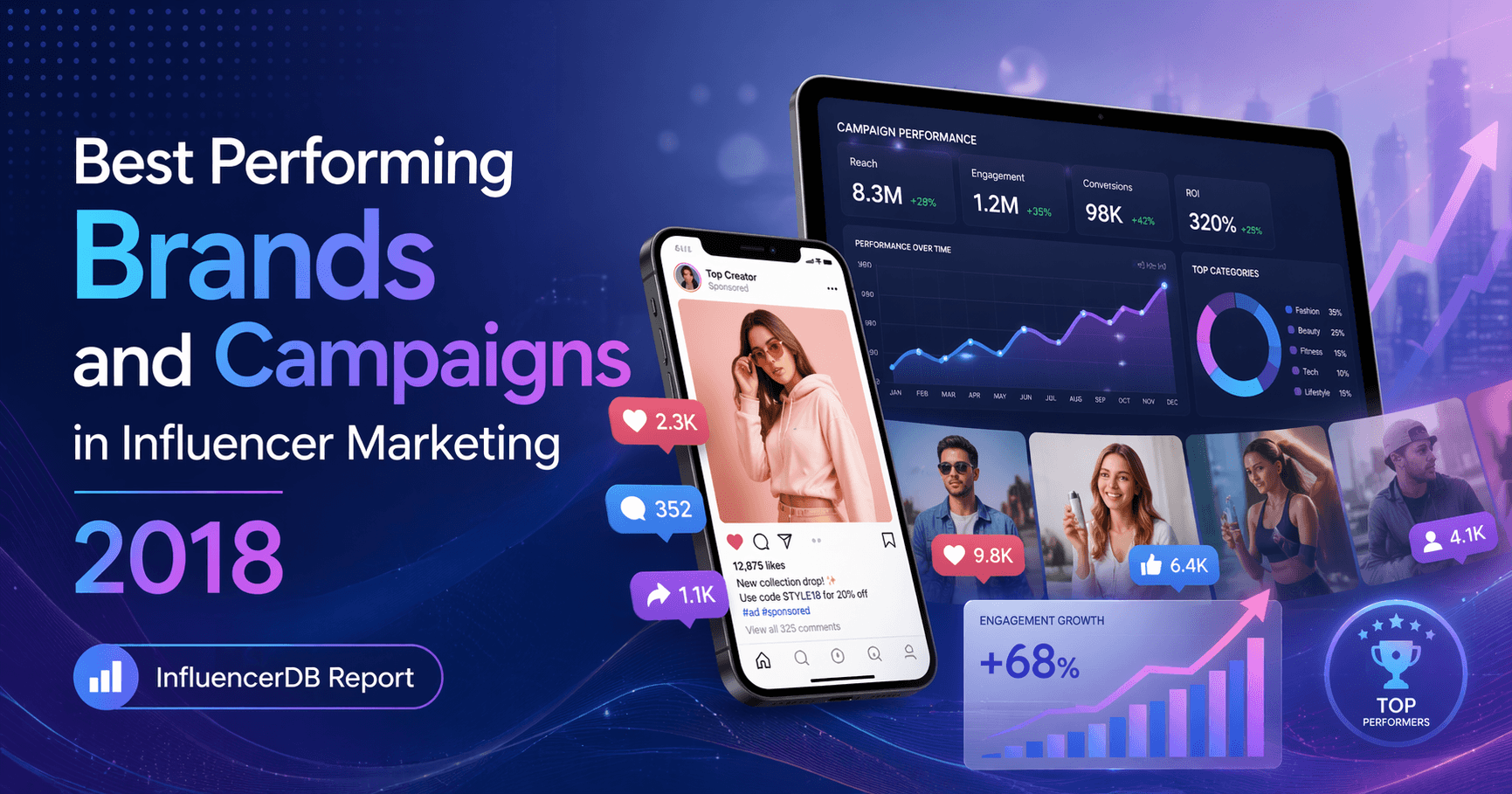

Influencer marketing 2018 was the year many brands stopped treating creators as a nice add on and started building repeatable, measurable playbooks. The best performing campaigns had a few things in common: clear objectives, tight creative constraints, smart creator selection, and measurement that went beyond likes. In this breakdown, you will learn what the strongest brands did differently, which campaign formats consistently performed, and how to apply the same mechanics to your next brief. Along the way, we will define the metrics that mattered, show simple formulas, and give you checklists you can copy into your workflow.
Influencer marketing 2018: what “best performing” really meant
Before you copy a tactic, you need a shared definition of performance. In 2018, brands increasingly judged influencer work on business outcomes, not just vanity metrics. That shift pushed teams to clarify whether a campaign was built for awareness, consideration, or conversion. It also forced cleaner reporting: reach and impressions for top of funnel, engagement rate for creative resonance, and CPA or ROAS for bottom funnel.
Use these practical definitions so your team stops arguing about what success looks like:
- Reach – unique people who saw the content at least once.
- Impressions – total views, including repeat views by the same person.
- Engagement rate (ER) – engagements divided by impressions or followers (be explicit which). A simple version: ER = (likes + comments + saves + shares) / impressions.
- CPM (cost per mille) – cost per 1,000 impressions. Formula: CPM = (cost / impressions) x 1000.
- CPV (cost per view) – cost per video view, typically on YouTube or TikTok. Formula: CPV = cost / views.
- CPA (cost per acquisition) – cost per purchase, lead, or app install. Formula: CPA = cost / conversions.
- Whitelisting – creator grants the brand permission to run ads through the creator’s handle (often called branded content ads).
- Usage rights – permission to reuse the content (organic, paid, duration, and channels should be specified).
- Exclusivity – creator agrees not to work with competitors for a defined period and category.
Takeaway: Pick one primary KPI and one supporting KPI per campaign phase, then align pricing and reporting to those two numbers. If you do not, you will overpay for the wrong deliverable and under measure what matters.
What the best brands did in 2018: repeatable patterns you can still use

Across categories like beauty, fashion, fitness, and consumer tech, top programs shared a few operational habits. First, they treated creator selection like media buying: audience fit, content fit, and distribution fit all had to pass. Second, they built campaigns in waves, using early posts to learn and later posts to scale. Third, they negotiated rights and whitelisting early, which let them turn organic creator content into paid assets without scrambling.
Here are the patterns that showed up again and again, plus how to apply them now:
- Micro and mid tier stacking – instead of one celebrity post, brands hired 15 to 50 smaller creators to increase frequency and creative variety. Action: plan a “creator mix” with 60 to 80 percent micro and mid tier, then reserve budget for 1 to 3 anchor creators if you need press or credibility.
- Clear creative guardrails – the best briefs gave creators freedom inside a tight box: 1 key message, 1 product proof point, 1 CTA. Action: write a brief with “must say” and “must show” lists, capped at 3 items each.
- Measurement by cohort – teams compared performance by creator tier, format, and hook, not just by creator name. Action: tag every post in your tracker with tier, format, and angle so you can learn quickly.
- Paid amplification – whitelisting turned high performing posts into scalable ads. Action: include whitelisting as an option line item in every contract, even if you do not use it.
Takeaway: If you want 2018 style “best performing” outcomes, build a system that produces learning. One viral post is luck. A wave based plan with tagging and amplification is repeatable.
Campaign formats that consistently won in 2018 (and why)
Not every format aged well, but several 2018 staples still work because they match how people evaluate products. Tutorials and routines made benefits tangible. Before and after stories created a simple narrative arc. Challenge formats encouraged participation and UGC. Meanwhile, unboxings and first impressions performed best when creators added a real test, not just packaging shots.
Use this decision rule: match the format to the buyer’s question. If the audience asks “does it work,” pick a demo or before and after. If they ask “is it for me,” pick a routine, day in the life, or styling set.
| Format | Best for | What to require in the brief | Primary KPI |
|---|---|---|---|
| Tutorial or routine | Consideration | 3 steps, 1 proof point, clear product shot | Watch time or saves |
| Before and after | Conversion | Time window, conditions, honest caveats | CTR or CPA |
| Challenge with hashtag | Awareness and UGC | Simple rules, repost plan, incentive | UGC volume and reach |
| Unboxing plus test | Awareness | First impression plus one real use case | Reach and completion rate |
| Creator discount code | Conversion | Unique code, landing page, expiry date | Code redemptions |
Takeaway: Do not buy a format because it is trendy. Buy it because it answers the audience’s next question, then measure the KPI that reflects that question.
Benchmarks and pricing logic: CPM, CPV, CPA with simple math
In 2018, many teams still priced deals as a flat fee per post. The best buyers, however, sanity checked pricing using CPM or CPV equivalents, then adjusted for rights, exclusivity, and production complexity. You can do the same today, even if the creator quotes a single number. Start by estimating expected impressions or views, then compute an implied CPM or CPV and compare across creators.
Example calculation: a creator quotes $2,500 for one Instagram Reel and you expect 50,000 impressions. Implied CPM = (2500 / 50000) x 1000 = $50 CPM. If another creator quotes $1,800 for 60,000 impressions, implied CPM is $30. That does not automatically mean the second creator is better, but it gives you a clean comparison.
| Pricing model | When it fits | Formula | Negotiation lever |
|---|---|---|---|
| Flat fee per deliverable | Awareness and creative testing | Implied CPM = (fee / impressions) x 1000 | Bundle multiple posts for a lower blended CPM |
| CPV based | Video first campaigns | CPV = fee / views | Define what counts as a view and the reporting window |
| CPA or affiliate | Direct response | CPA = total payout / conversions | Hybrid deal: smaller flat fee plus performance bonus |
| Whitelisting add on | Scaling winners with paid | Monthly fee + ad spend managed separately | Limit duration and platforms to control cost |
| Usage rights add on | Repurposing content | Fee x rights multiplier (based on duration and channels) | Shorter term rights with renewal option |
Takeaway: Always translate a quote into an implied CPM or CPV, then negotiate using levers that do not hurt the creator: bundles, clearer scope, shorter rights, or a hybrid performance structure.
A practical framework to build a top tier campaign brief
The best performing 2018 campaigns were rarely “winged.” They were briefed like a production: objective, audience, message, deliverables, and measurement were locked before outreach. If you want creators to deliver clean, on brand work without endless revisions, your brief must be specific while still leaving room for the creator’s voice.
Use this step by step framework:
- Objective and KPI – choose one: reach, consideration, or conversion. Define the KPI and reporting window.
- Audience and context – who is this for, and what problem are they solving today?
- Single minded message – one sentence the viewer should remember.
- Proof points – 1 to 2 claims the creator can demonstrate, not just state.
- Deliverables – format, quantity, length, posting dates, and whether drafts are required.
- Disclosure and brand safety – require clear ad disclosure and list prohibited claims.
- Tracking – UTM links, discount codes, landing page, and screenshots required.
- Rights and paid options – usage rights, whitelisting, and exclusivity terms.
For more templates and planning guidance, browse the InfluencerDB Blog and adapt the structure to your category. Also, if you run paid amplification, align your brief with platform rules for branded content so your posts are eligible for promotion. Meta’s branded content policies are a useful reference point: Meta Branded Content Policies.
Takeaway: A brief is not a mood board. It is a contract for outcomes. If you cannot measure it, rewrite it.
How to audit creators like the best teams did in 2018
Top brands in 2018 got stricter about creator vetting because fake followers and engagement pods were already a problem. They also learned that “fit” beats raw reach. A creator with smaller numbers but strong audience alignment often drove better conversion and lower CPA. The audit process does not need to be complicated, but it must be consistent.
Run this quick audit before you send an offer:
- Audience fit – scan comments for language, location hints, and buyer intent questions. Ask for audience screenshots if needed.
- Content fit – check the last 30 posts for production quality, tone, and how often they post ads.
- Engagement quality – look for specific comments, not just emojis. Sudden spikes can be a red flag.
- Performance evidence – request 2 to 3 recent post insights: reach, impressions, saves, shares, and link clicks.
- Brand safety – review past controversies, risky claims, and competitor conflicts.
When you need a disclosure baseline, use the FTC’s guidance on endorsements to set expectations for creators and your legal team: FTC Endorsement Guides.
Takeaway: Do not approve creators on aesthetics alone. Require proof of reach and engagement quality, then document it so your team can learn which signals predicted performance.
Common mistakes brands made in 2018 (and how to avoid them)
Even in a strong year, many campaigns underperformed for predictable reasons. The most common mistake was buying follower count instead of distribution. Another was over scripting creators, which produced stiff content and weak watch time. Teams also forgot to negotiate usage rights up front, then lost the chance to repurpose the best assets.
- Mismatch between KPI and deliverable – expecting conversions from a single awareness post. Fix: add a retargeting step or a second touchpoint with a code.
- No tracking plan – relying on screenshots and guesswork. Fix: use UTMs, unique codes, and a defined attribution window.
- Ignoring frequency – one post rarely moves a market. Fix: plan a wave: teaser, main post, reminder.
- Unclear rights – assuming you can repost everywhere. Fix: specify channels, duration, and paid usage in writing.
- Overlooking exclusivity costs – asking for broad exclusivity without paying for it. Fix: narrow the category and shorten the term, or pay a clear premium.
Takeaway: Most underperformance is operational, not creative. Tighten tracking, rights, and sequencing and results usually improve.
Best practices checklist: replicate “best performing” results now
To close, here is a practical checklist you can run before launch. It reflects what the best 2018 programs did well: clarity, consistency, and a bias toward learning. If you execute these steps, you will not need to guess which creators or formats work because your process will tell you.
- Set one primary KPI and one supporting KPI, then align deliverables to them.
- Build a creator mix across tiers and plan at least two waves of content.
- Translate every quote into implied CPM or CPV to compare fairly.
- Negotiate scope first – deliverables, revisions, timelines – then price.
- Lock rights in writing – usage rights, whitelisting, and exclusivity with clear durations.
- Standardize tracking – UTMs, codes, landing pages, and a reporting template.
- Run a post campaign review within 7 days: winners, losers, and one change for the next wave.
If you want to go deeper on measurement and campaign planning, keep a running library of your learnings and compare them against new tests each quarter. That discipline is what separated the best performing brands in 2018 from everyone else.